WhatsApp Business API Pricing: Complete 2026 Cost Breakdown
WhatsApp Business API pricing confuses almost everyone. Meta has changed the model multiple times — from session-based pricing to conversation-based pricing to the current per-template model introduced in 2025. Add in ISV (Independent Software Vendor) markups, volume discounts, and regional price differences, and it's no wonder businesses struggle to budget accurately.
This guide cuts through the complexity. You'll get the exact 2026 pricing for every message category, understand when you pay and when it's free, see real cost calculations for different business sizes, and learn how to minimize your WhatsApp API spend. We also break down how ChatDaddy — an official Meta ISV Partner serving 23,500+ businesses — structures its platform pricing to give you the best value.
Table of Contents
- WhatsApp Business API Pricing Overview (2026)
- Message Categories and What Each Costs
- Free Service Replies: The 24-Hour Window
- Per-Template Pricing Explained
- Regional Pricing: What You Pay by Country
- Volume Discounts and How to Qualify
- ISV Partner Platform Costs: ChatDaddy vs. Competitors
- Real Cost Calculations for Your Business
- 7 Ways to Reduce Your WhatsApp API Costs
- FAQ
WhatsApp Business API Pricing Overview (2026)
Here's the fundamental pricing structure you need to understand:
- Service conversations (free) — When a customer messages you first, all replies within 24 hours cost nothing. Zero. This is the biggest change Meta made in 2025/2026 and it dramatically reduces costs for businesses doing primarily customer support.
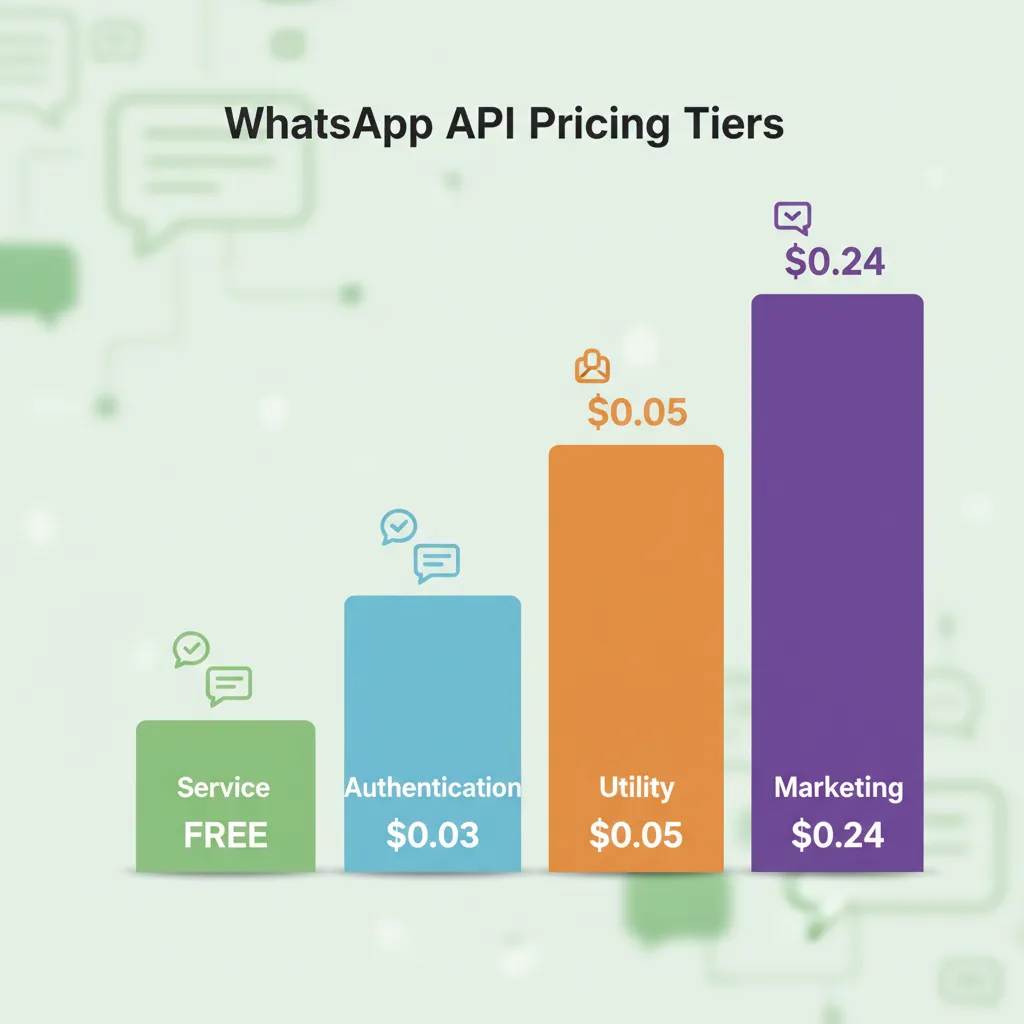
- Marketing templates (paid) — Outbound promotional messages, broadcasts, offers, and campaigns. These are the most expensive category, ranging from $0.03 to $0.24 per message depending on the recipient's country.
- Utility templates (paid, cheaper) — Order confirmations, shipping updates, appointment reminders, and other transactional messages. Priced lower than marketing templates.
- Authentication templates (paid, cheapest) — OTP codes, verification messages, and security alerts. The lowest-cost template category.
The key insight: if your business is primarily reactive (customers message you, you respond), your WhatsApp API costs could be close to zero. The costs stack up when you're sending outbound marketing campaigns to large contact lists.
Message Categories and What Each Costs
Marketing Templates
Used for: promotions, product launches, flash sales, newsletters, re-engagement campaigns, and any message designed to drive sales or awareness.
Pricing examples (per message):
- United States: $0.025
- United Kingdom: $0.058
- India: $0.025
- Brazil: $0.063
- Indonesia: $0.041
- Malaysia: $0.090
- Nigeria: $0.054
- Rest of world: varies by country
Utility Templates
Used for: order confirmations, delivery tracking, payment receipts, appointment reminders, account updates, and subscription notifications.
Utility messages typically cost 30-50% less than marketing templates for the same country. For example, a utility message to a US number costs roughly $0.015 versus $0.025 for marketing.
Authentication Templates
Used for: one-time passwords (OTPs), two-factor authentication codes, login verifications, and identity confirmations.
Authentication is the cheapest category, typically 50-70% less than marketing rates. These templates have strict formatting requirements — they must contain a one-time code and an expiry timeframe.
Service Conversations
Used for: any reply to a customer who messaged you first, within a 24-hour window. This includes customer support, sales inquiries, FAQ responses, and any reactive communication.
Cost: Completely free. This was Meta's biggest pricing change and it benefits businesses enormously. If a customer sends you a WhatsApp message and you reply within 24 hours, you pay nothing — regardless of how many messages you exchange in that window.
Free Service Replies: The 24-Hour Window
This is the single most important pricing concept to understand. Here's how it works in practice:
- Customer messages you at 2:00 PM Monday — a free 24-hour service window opens
- You reply at 2:05 PM — free
- You send a follow-up at 4:30 PM — still free (within 24 hours)
- Customer replies at 5:00 PM — window resets to 5:00 PM Tuesday
- You send product details at 9:00 AM Tuesday — still free (window extends to 5:00 PM Tuesday)
- No customer message by 5:01 PM Tuesday — window closes. Any new outbound message requires a paid template.
The strategic implication: maximize your engagement within 24-hour windows. Use ChatDaddy's chatbot to automatically engage customers the moment they message, ask qualifying questions, share product recommendations, and close sales — all within the free service window.
What Counts as a Customer-Initiated Message?
- Customer types a message to your WhatsApp number
- Customer clicks a Click-to-WhatsApp ad and sends the pre-filled message
- Customer scans your WhatsApp QR code and sends a message
- Customer clicks a wa.me link and sends a message
All of these open a free 24-hour window. Smart businesses design their marketing to drive inbound messages (via ads, QR codes, and website buttons) rather than relying solely on outbound broadcasts — because the resulting conversations are free.
Per-Template Pricing Explained
Meta's shift to per-template pricing in 2025 was a significant change. Here's what it means for your budgeting:
How Per-Template Pricing Works
Every time you send a template message (marketing, utility, or authentication), you're charged per recipient. The charge applies at the moment of delivery — not when the template is approved or scheduled.
Example scenario for a monthly broadcast campaign:
- You send 4 weekly marketing broadcasts to 5,000 contacts each
- Total template sends: 20,000 per month
- At $0.025/message (US rate): $500/month in API fees
- Plus ChatDaddy platform fee: $119-799/month depending on plan
- Total: $519-749/month
Template Approval and Categories
When you create a template in ChatDaddy, you select its category (marketing, utility, or authentication). Meta reviews the template content to ensure the category matches. If Meta reclassifies your "utility" template as "marketing," you'll be charged the higher marketing rate. Always be honest about template categorization to avoid surprises.
Regional Pricing: What You Pay by Country
| Region / Country | Marketing (per msg) | Utility (per msg) | Authentication (per msg) |
|---|---|---|---|
| United States | $0.025 | $0.015 | $0.013 |
| United Kingdom | $0.058 | $0.033 | $0.026 |
| India | $0.025 | $0.010 | $0.004 |
| Brazil | $0.063 | $0.035 | $0.027 |
| Indonesia | $0.041 | $0.020 | $0.016 |
| Malaysia | $0.090 | $0.050 | $0.036 |
| Mexico | $0.043 | $0.025 | $0.021 |
| Nigeria | $0.054 | $0.031 | $0.022 |
| Germany | $0.069 | $0.038 | $0.034 |
| UAE | $0.034 | $0.019 | $0.016 |
Note: Prices are approximate and subject to Meta's periodic updates. Check Meta's official pricing page for current rates.
The pricing varies because WhatsApp adoption and market dynamics differ by region. Markets where WhatsApp is the dominant communication platform (like Brazil, India, Indonesia) tend to have competitive pricing to encourage business adoption. European and some Asian markets command premium rates.
Multi-Market Cost Planning
If your business serves multiple countries, create a weighted cost estimate. For example, if 40% of your contacts are in India ($0.025), 30% in Malaysia ($0.090), and 30% in the US ($0.025), your blended marketing rate is approximately $0.039 per message.
Get the Best WhatsApp API Pricing with ChatDaddy
As a Meta ISV Partner, ChatDaddy passes through API costs at competitive rates with no hidden markups. Start free and scale as you grow.
Start Free TodayVolume Discounts and How to Qualify
Volume discounts make a massive difference at scale. Here's how they work:
Tiered Volume Pricing
| Monthly Message Volume | Approximate Discount | Effective Marketing Rate (US) |
|---|---|---|
| 0 - 10,000 | None (standard rate) | $0.025 |
| 10,001 - 100,000 | 5-10% | $0.023-0.024 |
| 100,001 - 500,000 | 10-15% | $0.021-0.023 |
| 500,001 - 1,000,000 | 15-20% | $0.020-0.021 |
| 1,000,000+ | Custom negotiation | Contact ISV Partner |
The key advantage of using a large ISV partner like ChatDaddy: because we aggregate messaging volume across 23,500+ businesses, we qualify for the highest volume tiers and pass savings through to all our customers — even those sending smaller volumes individually.
ISV Partner Platform Costs: ChatDaddy vs. Competitors
Your total WhatsApp Business API cost has two components:
- WhatsApp API charges — paid to Meta (per-template fees described above)
- ISV platform fee — paid to your platform provider (ChatDaddy, WATI, etc.) for the software, shared inbox, chatbot builder, analytics, and support
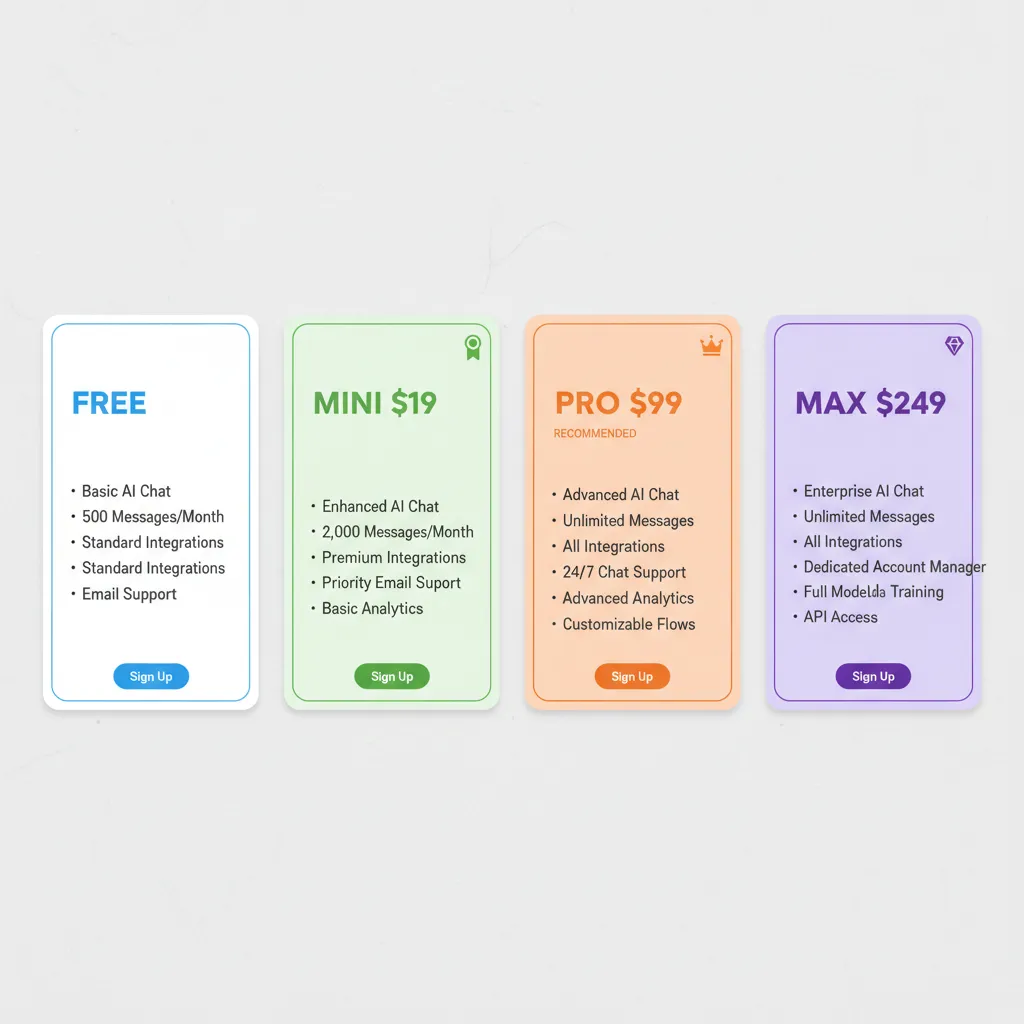
| ISV Partner Platform | Free Plan | Starter | Mid-Tier | Enterprise | API Markup |
|---|---|---|---|---|---|
| ChatDaddy | Yes (full features) | $119/mo | $299/mo | $799/mo | Competitive pass-through |
| WATI | No | $49/mo | $99/mo | $299/mo | Standard markup |
| Respond.io | No | $99/mo | $279/mo | Custom | Included in plan |
| Trengo | No | $113/mo | $170/mo | Custom | Per-conversation fee |
| Interakt | No | $15/mo | $35/mo | $55/mo | Standard markup |
ChatDaddy's pricing structure is designed for businesses that want to start small and scale. The free plan includes a shared inbox, chatbot builder, broadcast messaging, and API access — everything you need to get started. Paid plans unlock advanced features like AI-powered automation, advanced analytics, and priority support. ChatDaddy also offers WhatsApp Coexistence — the ability to use the Business API and the normal WhatsApp Business App on the same number simultaneously, free for all ChatDaddy customers.
ChatDaddy Plans Breakdown
- Free — shared inbox, basic chatbot, broadcast, API access. Perfect for testing and small volumes.
- Basic ($119/mo, 5 teammates) — everything in Free plus advanced chatbot flows, more integrations, and increased broadcast limits. Ideal for small businesses.
- Pro ($299/mo, 10 teammates) — everything in Basic plus AI-powered automation, advanced analytics, priority support, and custom integrations. Built for growing businesses.
- Max ($799/mo, 15 teammates) — everything in Pro plus dedicated account manager, custom development, SLA guarantees, and volume API discounts. For large teams and high-volume senders.
Real Cost Calculations for Your Business
Let's calculate real costs for three business scenarios:
Scenario 1: Small E-Commerce Store
- Contact list: 2,000 customers (US-based)
- Weekly broadcast: 1 campaign to full list = 8,000 messages/month
- Order confirmations (utility): 200/month
- Customer support (service): 500 conversations/month (free)
Monthly cost:
- Marketing templates: 8,000 x $0.025 = $200
- Utility templates: 200 x $0.015 = $3
- Service conversations: $0 (free)
- ChatDaddy Basic plan: $119
- Total: $222/month
Scenario 2: Mid-Size SaaS Company
- Contact list: 15,000 customers (global mix)
- Bi-weekly broadcast: 2 campaigns to segmented lists = 20,000 messages/month
- Onboarding sequences (utility): 1,000/month
- Authentication OTPs: 3,000/month
- Customer support: 2,000 conversations/month (free)
Monthly cost:
- Marketing templates: 20,000 x $0.040 (blended) = $800
- Utility templates: 1,000 x $0.020 = $20
- Authentication: 3,000 x $0.015 = $45
- Service conversations: $0
- ChatDaddy Pro plan: $299
- Total: $964/month
Scenario 3: Large Retail Brand
- Contact list: 200,000 customers (Southeast Asia focus)
- Weekly campaigns: 4 per month to segments = 300,000 messages/month
- Order/shipping updates: 50,000/month
- Support: 10,000 conversations/month (free)
Monthly cost (with ~15% volume discount):
- Marketing templates: 300,000 x $0.055 (SEA blended, after discount) = $16,500
- Utility templates: 50,000 x $0.030 = $1,500
- Service conversations: $0
- ChatDaddy Max plan: $799
- Total: $18,249/month
7 Ways to Reduce Your WhatsApp API Costs
1. Drive Inbound Messages (Free Conversations)
Every customer-initiated conversation is free for 24 hours. Use Click-to-WhatsApp ads, website chat buttons, QR codes, and social media CTAs to get customers to message you first. Then use the free window to qualify, recommend, and sell.
2. Segment Your Broadcasts
Don't send every campaign to your entire list. Segment by engagement, purchase history, and relevance. Sending to 5,000 highly engaged contacts beats blasting 20,000 where 15,000 don't care. You save on API costs and maintain your quality rating.
3. Use Correct Template Categories
Order confirmations and shipping updates qualify as utility templates, which cost 30-50% less than marketing. Ensure you're categorizing templates correctly. A "Your order has shipped" message should be utility, not marketing.
4. Maximize the 24-Hour Window
When a customer messages you, make the most of that free window. Use ChatDaddy's chatbot to automatically engage, qualify, recommend products, and close — all within the free 24-hour period.
5. Clean Your Contact List
Remove invalid numbers, inactive contacts, and people who consistently don't engage. Every undelivered message still costs you. Regular list hygiene (monthly) can reduce costs by 10-20%.
6. Optimize Send Times
Messages sent at optimal times get higher engagement, fewer blocks, and better quality ratings. Poor timing leads to more "block" and "report" actions, which can escalate to messaging restrictions. Use ChatDaddy's analytics to identify the best send windows for your audience.
7. Choose the Right ISV Partner
ISV markups vary significantly. Some charge per-message fees on top of Meta's rates, others include API costs in the platform fee, and some like ChatDaddy offer competitive pass-through pricing. Compare total costs (platform + API), not just platform fees. A $15/month platform with high API markups can cost more than ChatDaddy's $299/month Pro plan at scale.
Related Articles
- WhatsApp API Integration Guide: Complete Developer Setup for 2026
- WhatsApp API Pricing in 2026: Complete Cost Breakdown and Provider Comparison
- Best WhatsApp API Provider in 2026: How to Choose the Right Partner
- WhatsApp Business API: Complete Guide for 2026
- WhatsApp Business API Argentina: The Complete Guide for Argentine Businesses in 2026
Frequently Asked Questions
How much does WhatsApp Business API cost per message?
WhatsApp Business API costs depend on the message category and recipient's country. Marketing messages cost $0.025-0.090 per message, utility messages cost $0.010-0.050, and authentication messages cost $0.004-0.036. Service replies within 24 hours of a customer message are completely free. These are Meta's API charges, separate from your ISV platform fee.
Is WhatsApp Business API free?
The WhatsApp Business API itself is free to access — there's no setup fee or monthly API subscription. You only pay per-template charges when sending outbound messages, and service replies within 24 hours are free. However, you need a ISV platform to use the API, and most charge a monthly fee. ChatDaddy offers a free plan so you can start at zero cost.
What are free service conversations on WhatsApp?
Free service conversations occur when a customer messages your business first. You can reply for free for 24 hours from their last message. This window resets every time the customer sends a new message. After 24 hours without a customer message, you must use a paid template to re-initiate contact. This applies to all businesses using the WhatsApp Business API.
How do volume discounts work for WhatsApp API?
Meta offers volume discounts of up to 20% for high-volume senders, typically applied at the ISV partner level. Businesses sending 100,000+ messages per month start qualifying for discounts. Using a large ISV partner like ChatDaddy (serving 23,500+ businesses) gives you access to aggregated volume pricing that smaller providers can't offer.
What is the difference between WhatsApp Business App and API pricing?
The WhatsApp Business App is completely free but limited to one device, 256-contact broadcasts, and no automation. The WhatsApp Business API charges per-template for outbound messages but offers unlimited contacts, multi-agent access, automation, chatbots, and integrations. For businesses with more than 50 daily conversations, the API's capabilities justify the cost.
How much does ChatDaddy cost for WhatsApp API?
ChatDaddy platform plans are: Free (full basic features), Basic at $119/month, Pro at $299/month, and Max at $799/month. WhatsApp API conversation charges from Meta are additional and vary by message category and recipient country. ChatDaddy passes through API costs at competitive rates with no hidden markups.
Can I use WhatsApp Business API without an ISV partner?
Technically yes — you can apply for direct API access through Meta's Cloud API. However, this requires significant technical setup, server management, and compliance handling. Most businesses use an ISV partner like ChatDaddy because it provides a ready-to-use dashboard, chatbot builder, shared inbox, broadcast tools, and support — without any development work.
How can I reduce my WhatsApp API costs?
The most effective strategies are: drive inbound messages (free service conversations), segment broadcasts to send only to engaged contacts, use utility templates instead of marketing where applicable, maximize the 24-hour free window for sales conversations, clean your contact list regularly, and choose an ISV partner like ChatDaddy that offers volume discounts and competitive pass-through pricing.