WhatsApp vs Email Marketing 2026: Data-Driven Comparison — Which Drives More Sales?
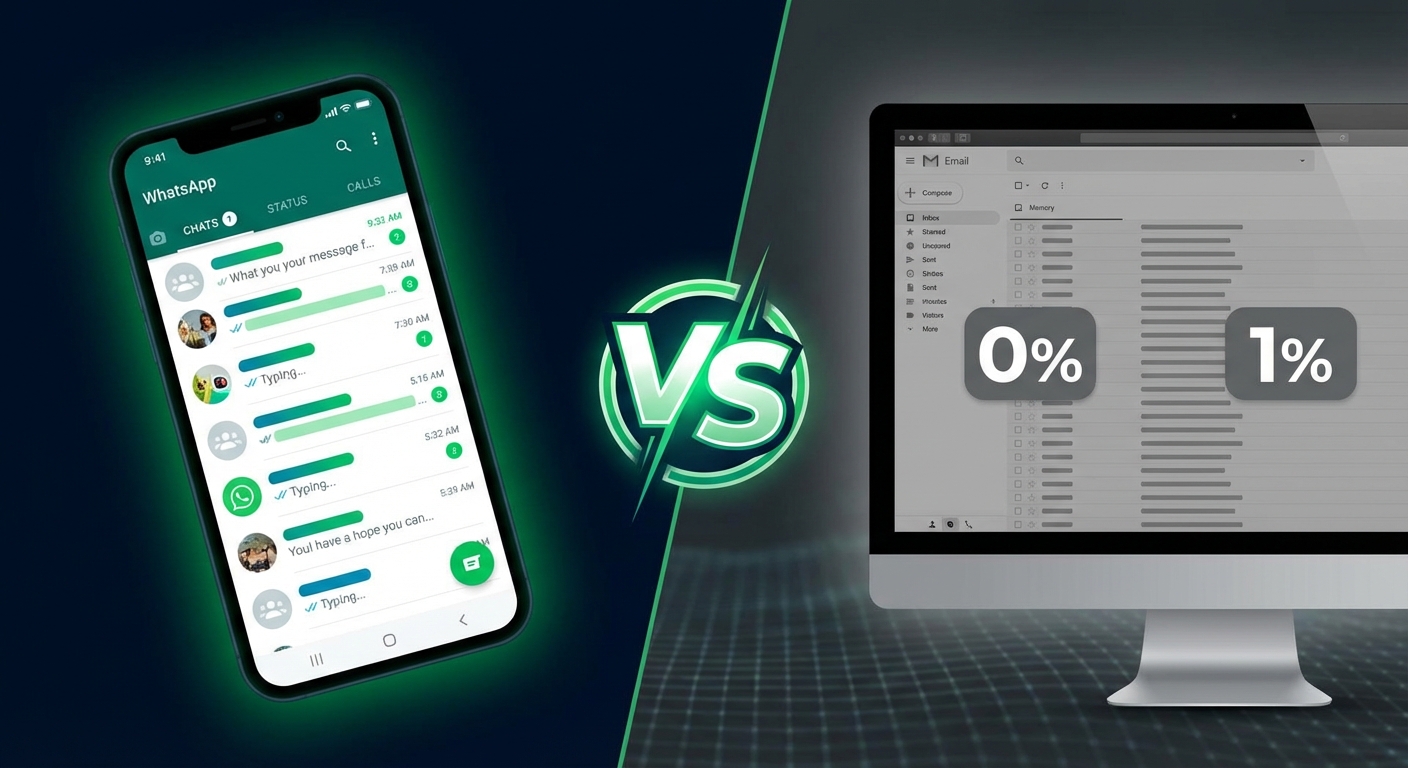
The marketing world has a new default channel, and it is not sitting in your inbox. WhatsApp delivers 98% open rates versus email's 20%, click-through rates that are 10-15x higher, and conversion costs that make email's ROI look like a rounding error. In 2026, businesses using WhatsApp marketing alongside email report 30-50% higher overall conversion rates — yet email marketing still commands the largest share of marketing budgets worldwide.
So which channel actually drives more sales in 2026? The answer is more nuanced than the headline metrics suggest. WhatsApp dominates in engagement, speed, and conversion rate — but email still holds advantages in scale, content depth, and certain lifecycle stages. The smartest businesses are not choosing one or the other. They are building hybrid strategies that leverage each channel's unique strengths.
This guide presents a data-driven comparison of WhatsApp marketing versus email marketing in 2026, covering open rates, click-through rates, conversion rates, cost per message, ROI, and — most importantly — a practical framework for deciding when to use each channel and how to combine them for maximum revenue.
Table of Contents
- Head-to-Head: WhatsApp vs Email by the Numbers
- Open Rates: 98% vs 20% — Why the Gap Exists
- Click-Through and Conversion Rate Comparison
- Cost Per Message and ROI Comparison
- When to Use WhatsApp vs Email
- The Hybrid Strategy: Combining Both Channels
- Channel Selection Framework
- Frequently Asked Questions
- Conclusion
1. Head-to-Head: WhatsApp vs Email by the Numbers
Before diving into the nuances, here is the complete performance comparison between WhatsApp and email marketing in 2026, based on aggregated data from industry benchmarks and ChatDaddy's platform analytics across 23,500+ businesses:
| Metric | Winner | ||
|---|---|---|---|
| Open Rate | 95-98% | 18-22% | |
| Click-Through Rate | 45-60% | 2-5% | |
| Conversion Rate | 8-15% | 1-3% | |
| Average Response Time | < 3 minutes | 90+ minutes | |
| Cost Per Message | $0.01-0.08 | $0.001-0.01 | |
| Cost Per Conversion | $0.50-2.00 | $5-20 | |
| Content Length | Short (1024 chars) | Unlimited | |
| Rich Media | Images, video, documents, locations | Full HTML/CSS design | Tie |
| List Size Potential | Opt-in dependent, growing | Mature, large lists | |
| Spam Filter Risk | None (direct delivery) | High (15-30% filtered) | |
| Two-Way Communication | Native, instant | Rare, delayed | |
| Automation Maturity | Rapidly improving | Highly mature |
Table 1: WhatsApp vs Email marketing — complete performance comparison for 2026

Figure 1: WhatsApp vs Email marketing metrics comparison — 2026
2. Open Rates: 98% vs 20% — Why the Gap Exists
The 78-percentage-point gap between WhatsApp and email open rates is not a fluke or a marketing gimmick — it is driven by fundamental differences in how the two channels work:
2.1 Delivery Mechanism
WhatsApp messages arrive as push notifications on the user's phone — the same way personal messages from friends and family appear. There is no spam folder, no promotions tab, no "other" inbox. The message lands directly in the chat list, accompanied by a sound or vibration notification. Users instinctively check these messages because their brain processes them as personal communication.
Email, conversely, must navigate multiple filtering layers before reaching the inbox: SPF/DKIM authentication, spam scoring, content filtering, reputation checks, and finally the recipient's own inbox rules. Gmail's Promotions tab alone diverts 68% of marketing emails away from the Primary inbox. Even if your email survives all filters, it lands in an inbox alongside 50-100+ other unread messages competing for attention.
2.2 Attention Economics
The average person receives 121 emails per day but only 8-12 business WhatsApp messages per day. WhatsApp messages are scarce relative to the noise, which makes each one more valuable and more likely to be opened. As WhatsApp marketing grows, this ratio will shift — but in 2026, the attention advantage remains massive.
2.3 Trust and Context
WhatsApp is where people talk to people. When a business message appears in the same app where users chat with family, there is an implicit trust transfer. Users have also explicitly opted in to receive messages (WhatsApp requires documented consent), which means they expect and welcome the communication. Email opt-ins, by contrast, often come from vague checkbox consent during e-commerce checkout, resulting in lower engagement intent.

Figure 2: Why WhatsApp open rates crush email — delivery path comparison
3. Click-Through and Conversion Rate Comparison
3.1 Click-Through Rates
WhatsApp's CTR advantage comes from three structural factors:
- Interactive buttons — WhatsApp templates include tappable quick-reply and CTA buttons directly below the message. Tapping a button requires zero effort compared to finding and clicking a hyperlink buried in an email body. ChatDaddy's broadcast templates support up to 3 quick-reply buttons and 2 CTA buttons per message.
- Single-focus interface — A WhatsApp message occupies the full screen. There are no sidebars, ads, navigation menus, or competing content. The user's attention is entirely on your message and your CTA.
- Conversational momentum — Users are already in a "chatting" mindset when reading WhatsApp messages. Tapping a button to continue the conversation feels natural, not transactional.
3.2 Conversion Rates
The conversion rate gap is even more significant than CTR, because WhatsApp enables in-chat purchasing that eliminates the conversion-killing redirect to external websites. A customer sees a product, taps "Buy Now," confirms details inside WhatsApp via a shop catalog, and completes the purchase — all without opening a browser. Compare this to email, where the user must click a link, wait for a page to load, navigate a website, add to cart, enter shipping details, and complete checkout. Each step loses 20-40% of users.
ChatDaddy customers using in-chat commerce report conversion rates of 12-18% from WhatsApp campaigns versus 1.5-2.5% from equivalent email campaigns promoting the same products to the same audience segments.
| Campaign Type | WhatsApp CTR | Email CTR | WhatsApp Conversion | Email Conversion |
|---|---|---|---|---|
| Product Launch | 55% | 4.2% | 12% | 2.1% |
| Flash Sale | 62% | 5.1% | 15% | 2.8% |
| Cart Abandonment | 48% | 3.8% | 18% | 3.5% |
| Re-engagement | 38% | 2.1% | 8% | 1.2% |
| Newsletter/Content | 42% | 3.5% | 5% | 1.0% |
Table 2: CTR and conversion rates by campaign type — WhatsApp vs Email, 2026
4. Cost Per Message and ROI Comparison
4.1 Per-Message Costs
Email is undeniably cheaper on a per-message basis. Sending 10,000 emails through a platform like Mailchimp or SendGrid costs approximately $10-100 (essentially $0.001-0.01 per email). Sending 10,000 WhatsApp marketing messages costs approximately $100-800 depending on the country, Meta's per-message pricing tier, and your provider's markup.
At first glance, this makes email appear 10-100x more cost-effective. But per-message cost is a vanity metric. The metric that matters is cost per conversion.
4.2 Cost Per Conversion
When you factor in the massive engagement and conversion rate differences, the economics flip dramatically:
- Email: Send 10,000 emails at $0.005 each = $50. At 20% open rate and 3% CTR and 2% conversion = 12 conversions. Cost per conversion = $4.17.
- WhatsApp: Send 10,000 messages at $0.04 each = $400. At 98% open rate and 50% CTR and 12% conversion = 588 conversions. Cost per conversion = $0.68.
WhatsApp delivers 49x more conversions from the same audience size, at a 6x lower cost per conversion. The total spend is higher, but the return per dollar is dramatically better.
4.3 ROI Comparison
| Metric | WhatsApp (10K messages) | Email (10K messages) |
|---|---|---|
| Total Send Cost | $400 | $50 |
| Messages Opened | 9,800 | 2,000 |
| Clicks Generated | 4,900 | 100 |
| Conversions | 588 | 12 |
| Revenue (at $50 AOV) | $29,400 | $600 |
| ROI | 7,250% | 1,100% |
| Cost Per Conversion | $0.68 | $4.17 |
Table 3: ROI comparison — WhatsApp vs Email for identical 10,000-contact campaign

Figure 3: ROI comparison — WhatsApp vs Email for 10,000-contact campaign
5. When to Use WhatsApp vs Email
5.1 When WhatsApp Wins
- Time-sensitive offers — Flash sales, limited-time promotions, and expiring deals. WhatsApp's instant open rates mean your offer is seen within minutes, not hours.
- Cart abandonment recovery — Send a reminder 1-4 hours after abandonment. WhatsApp cart recovery rates reach 45-60% versus email's 8-12%.
- Order and delivery updates — Transaction confirmations, shipping notifications, and delivery tracking. Customers prefer these in WhatsApp (real-time, mobile-native) over email.
- Customer support — Two-way conversation is native to WhatsApp. Use team inbox and chatbot capabilities for instant resolution.
- High-value conversions — When the conversion value justifies the higher per-message cost. B2B lead qualification, high-ticket e-commerce, appointment bookings.
- Markets where WhatsApp dominates — Southeast Asia, Latin America, Middle East, Africa, and parts of Europe where WhatsApp is the primary communication channel.
5.2 When Email Wins
- Long-form content — Detailed guides, reports, case studies, and educational content that requires more than 1024 characters.
- Design-heavy communications — Brand campaigns that rely on elaborate HTML/CSS layouts, rich typography, and complex visual designs.
- Large-scale cold outreach — Email's low per-message cost makes it viable for large-volume, lower-intent top-of-funnel campaigns.
- Archival communications — Contracts, invoices, legal documents, and records that recipients need to search and reference later.
- Markets where email dominates — North America and parts of Europe where professional communication still centers on email.
- Mature automation sequences — Complex drip campaigns with 10+ touchpoints are easier to manage in established email automation platforms, though WhatsApp automation is catching up fast.
6. The Hybrid Strategy: Combining Both Channels
The either/or framing is a false choice. The most successful businesses in 2026 are using both channels strategically, with each channel handling what it does best:
6.1 The Email-to-WhatsApp Escalation Model
- Email broadcasts content — Send weekly newsletters, product updates, and educational content via email to your full list. This is cost-effective for broad awareness.
- Email identifies intent signals — Track which recipients open emails, click links, and visit product pages. These are your high-intent prospects.
- WhatsApp converts high-intent leads — Send targeted WhatsApp messages to the high-intent segment with personalized offers and direct CTA buttons. The conversion rate on these warm leads via WhatsApp is 3-5x higher than sending another email.
- WhatsApp handles post-purchase — Order confirmations, shipping updates, review requests, and re-purchase reminders all go through WhatsApp for maximum visibility and engagement.
6.2 Practical Implementation
Here is a concrete example of a hybrid customer journey for an e-commerce business:
- Day 0: Customer signs up on your website. Send welcome email with brand story and product catalog (email).
- Day 1: Customer opened email and clicked a product. Send WhatsApp message with that specific product and a 10% welcome discount (WhatsApp via broadcast).
- Day 3: Customer added to cart but did not purchase. Send cart recovery message on WhatsApp with product image and one-tap checkout (WhatsApp).
- Day 5: Customer purchased. Send order confirmation and tracking on WhatsApp (WhatsApp).
- Day 14: Send a product care guide and cross-sell recommendations via email (email).
- Day 30: Send a personalized WhatsApp message with loyalty reward and re-purchase incentive (WhatsApp).

Figure 4: Hybrid WhatsApp + Email customer journey — using each channel for maximum impact
7. Channel Selection Framework
Use this decision framework to determine which channel to use for each communication:
| Question | If Yes: Use WhatsApp | If No: Use Email |
|---|---|---|
| Is this time-sensitive (must be seen within 1 hour)? | Email is fine | |
| Does this require a customer response? | Email is fine | |
| Is the conversion value > $20? | WhatsApp (ROI justifies cost) | Email (save message cost) |
| Is the content > 500 words? | ||
| Does this need complex visual design? | ||
| Is the recipient in a WhatsApp-dominant market? | Email (or test both) | |
| Is this a transactional update (order, shipping)? | Email as backup | |
| Is this a re-engagement for lapsed customers? | Email as first touch |
Table 4: Channel selection decision framework — WhatsApp vs Email
Ready to Add WhatsApp to Your Marketing Mix?
ChatDaddy is a Meta ISV Partner. Get WhatsApp API access, broadcast tools, automation, and CRM integration — trusted by 23,500+ businesses worldwide.
Start Your Free Trial8. Frequently Asked Questions
Is WhatsApp marketing better than email marketing?
WhatsApp marketing outperforms email in open rates (98% vs 20%), click-through rates (45-60% vs 2-5%), and conversion rates (8-15% vs 1-3%). However, email is better for long-form content, design-heavy campaigns, and large-scale low-cost outreach. The best strategy in 2026 combines both channels based on message type, urgency, and audience.
What is the open rate for WhatsApp vs email?
WhatsApp messages achieve 95-98% open rates, while marketing emails average 18-22% open rates in 2026. The gap exists because WhatsApp delivers messages as push notifications with no spam filtering, while email must survive multiple filters and compete with crowded inboxes.
Is WhatsApp marketing more expensive than email?
WhatsApp costs more per message ($0.01-0.08) than email ($0.001-0.01). However, WhatsApp's dramatically higher conversion rates result in a lower cost per conversion ($0.50-2.00 vs $5-20) and higher overall ROI. For revenue-focused campaigns, WhatsApp is more cost-effective despite the higher per-message price.
Can I use WhatsApp and email together?
Yes, and you should. A hybrid strategy uses email for broad content distribution and top-of-funnel nurturing, then escalates to WhatsApp for high-intent conversions and time-sensitive communications. Businesses using hybrid WhatsApp-email strategies report 30-50% higher overall conversion rates than single-channel approaches.
Should I replace my email marketing with WhatsApp?
No. Do not replace email with WhatsApp — add WhatsApp alongside email. Email remains valuable for long-form content, design-rich campaigns, archival communications, and cost-effective large-scale outreach. The optimal approach is a hybrid strategy where each channel handles what it does best.
What is the cost per conversion for WhatsApp vs email marketing?
WhatsApp costs $0.50-2.00 per conversion on average, compared to $5-20 for email marketing. Despite WhatsApp's higher per-message cost ($0.01-0.08 per message vs $0.001-0.01 for email), the dramatically higher conversion rates (8-15% vs 1-3%) produce significantly lower cost per acquisition. For high-AOV products and services, WhatsApp's cost per conversion advantage is even more pronounced.
Can I segment my WhatsApp marketing campaigns like email?
Yes. With WhatsApp Business API platforms like ChatDaddy, you can segment your broadcast lists by purchase history, location, customer tags, lifecycle stage, engagement behavior, and custom fields. Advanced segmentation in WhatsApp produces the same personalization benefits as email segmentation, combined with WhatsApp's superior open and click rates.
How do I build a WhatsApp marketing list legally?
Every WhatsApp marketing contact requires explicit opt-in consent before you can send marketing messages. Legal opt-in methods include website forms, Click-to-WhatsApp ads, keyword opt-ins (text START to receive updates), QR codes, and in-person sign-ups. You must clearly state what subscribers will receive and provide an easy opt-out mechanism. This is required by both Meta's Business Policy and data protection regulations.
9. Conclusion
The data is clear: WhatsApp marketing delivers superior engagement, higher conversions, and better ROI than email marketing in 2026. With 98% open rates, 45-60% click-through rates, and conversion rates that run 5-8x higher than email, WhatsApp is the highest-performing direct marketing channel available today.
But the smartest answer to "WhatsApp vs Email" is not either/or — it is both, strategically deployed. Use email for what it does best: long-form content, broad distribution, and cost-effective nurturing. Use WhatsApp for what it does best: instant engagement, high-value conversions, real-time support, and post-purchase communication. Connect both channels through a platform like ChatDaddy that integrates CRM, automation, and analytics across your entire messaging stack.
The businesses winning in 2026 are not choosing between channels. They are building hybrid systems that meet customers wherever they are, with the right message on the right channel at the right moment. Get started with ChatDaddy and add WhatsApp to your marketing mix today.
